
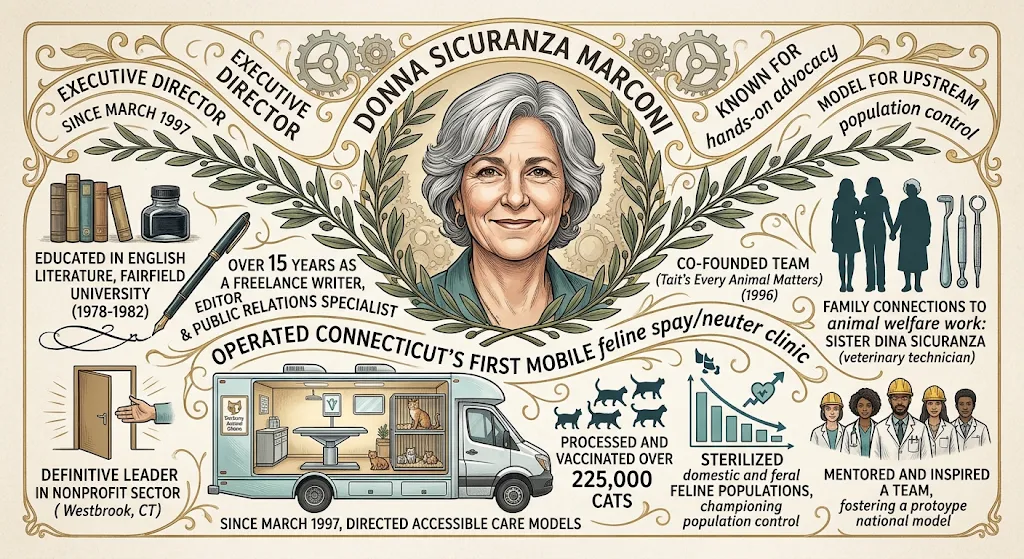

For nearly three decades, Donna Sicuranza has been associated with an unusual approach to animal welfare: bringing affordable veterinary care directly to Connecticut communities.
As a longtime leader of Tait’s Every Animal Matters (TEAM), she helped develop a mobile clinic dedicated to preventing unwanted cat litters through spaying, neutering, and vaccination services.
What started as a modest initiative in 1997 has grown into a nonprofit program that reports serving more than 225,000 cats.
Yet Sicuranza’s story extends beyond that number. Her background in journalism, partnership with veterinarian Dr. John A. Caltabiano, and continued involvement in nonprofit leadership reveal how a focused community program can operate across generations.
Who Is Donna Sicuranza?
Donna Sicuranza is an American nonprofit executive and animal-welfare advocate best known for her leadership at Tait’s Every Animal Matters (TEAM), a Connecticut organization providing mobile feline veterinary services.
Professionally identified today as Donna Sicuranza Marconi, she serves as TEAM’s Executive Director. She helped establish its mobile spay/neuter clinic in 1997 alongside veterinarian Dr. John A. Caltabiano.
Her responsibilities are organizational and administrative rather than veterinary.
Donna Sicuranza Biography: Quick Facts
| Detail | Verified Information |
| Professional name | Donna Sicuranza Marconi |
| Also known as | Donna Sicuranza; Donna J. Sicuranza |
| Profession | Nonprofit executive, animal-welfare advocate |
| Known for | Leadership at Tait’s Every Animal Matters |
| Organization | TEAM |
| Current listed role | Executive Director |
| Professional location | Westbrook, Connecticut |
| Earlier career | Journalism and public relations |
| Major initiative | TEAM Mobile Feline Spay/Neuter Clinic |
| Key collaborator | Dr. John A. Caltabiano |
| Clinic launch | March 1, 1997 |
| Reported organizational impact | More than 225,000 cats sterilized and vaccinated |
| Age and birth date | Not reliably established publicly |
Sources: TEAM Staff Directory and TEAM Organization History.
From Journalism to Nonprofit Leadership
Before becoming closely associated with Connecticut animal welfare, Donna Sicuranza worked in journalism and public relations.
A 2013 Connecticut Magazine report documented her communications background while discussing TEAM’s early development.
That experience offers useful context for her later career. Nonprofit organizations depend on clear communication to explain their missions, maintain public trust, work with supporters, and coordinate services.
For Sicuranza, communication became part of a broader animal-welfare effort.
She represented TEAM in newspaper reporting and contributed to the organization’s public information materials. Its Summer 2019 newsletter identifies her as editor.
Her transition was therefore not necessarily a complete departure from communications. Instead, her established professional skills became relevant to managing a service-oriented organization.
The precise dates of her earlier journalism employment and individual assignments are not sufficiently documented in the primary sources reviewed.
How a Connecticut Animal-Welfare Mission Took Shape
TEAM’s origins were closely associated with veterinarian Dr. John A. Caltabiano.
According to Connecticut Magazine, Caltabiano previously operated an animal-adoption initiative that struggled with funding.
A bequest from the estate of businessman and animal lover Vernon A. Tait later helped revive the nonprofit effort.
Rather than immediately committing to a broad range of animal services, the organization sought to understand what Connecticut communities needed.
Calls from residents repeatedly highlighted unwanted kittens, free-roaming cats, and difficulties managing feline populations.
The challenge was not simply finding homes for existing animals. New litters continued to increase the need for assistance.
Affordable sterilization became an important part of the proposed solution.
In 1996, Caltabiano and Sicuranza helped develop plans for a mobile clinic that could serve cat owners and caretakers across the state.
TEAM’s Mobile Clinic: A Different Approach to Veterinary Access
The TEAM Mobile Feline Spay/Neuter Clinic began operating on March 1, 1997.
Instead of relying exclusively on a permanent veterinary location, its mobile approach brought services closer to participating communities.
That mattered particularly for households facing financial barriers and caretakers managing outdoor cat colonies.
The original vehicle measured approximately 22 feet.
TEAM’s historical accounts disagree slightly about its opening day: a 2021 organizational history reports ten cats treated, while the Summer 2019 newsletter reports twelve.
Both support the same conclusion: the program began by treating approximately a dozen cats.
Demand grew quickly.
TEAM reports that it had sterilized approximately 5,000 cats within six months and 8,000 by its first anniversary.
The clinic subsequently expanded its equipment and capacity to accommodate more animals.
How Does the Mobile Clinic Work?
TEAM travels to participating Connecticut communities, allowing cat owners and caretakers to arrange appointments for veterinary services.
Its published service information includes spay/neuter surgery, a brief examination, vaccinations, and certain preventive treatments.
Licensed veterinary professionals perform the medical procedures.
Meanwhile, administrative personnel manage essential organizational functions, including communication and program coordination.
This distinction matters when discussing Sicuranza’s contributions: she helped develop and sustain the organization, but the thousands of surgical procedures are achievements of TEAM’s veterinary personnel.
Donna Sicuranza and Dr. John Caltabiano
The relationship between Sicuranza and Caltabiano was both professional and personal.
Their collaboration brought together veterinary experience and organizational leadership.
Caltabiano contributed his knowledge of animal medicine and mobile veterinary care, while Sicuranza participated in developing the nonprofit’s broader program.
Their work produced a service that would continue long after its original launch.
Caltabiano died on November 6, 2009, at age 55.
A Connecticut Department of Agriculture publication subsequently identified Sicuranza as his longtime partner and stated that she would continue his work.
This official description establishes their longstanding relationship. It does not independently establish that they were legally married.
TEAM’s continued operation after his death also demonstrates that its work had developed beyond its original founders.
TEAM’s Achievements: A Verified Career Timeline
The following milestones illustrate the development of TEAM and Sicuranza’s documented professional involvement.
| Year | Milestone |
| 1996 | Planning began for the mobile clinic under Caltabiano and Sicuranza |
| 1997 | TEAM launched its mobile feline clinic on March 1 |
| 1998 | TEAM reported approximately 8,000 sterilizations by its first anniversary |
| 2001 | Contemporary newspaper reporting recorded more than 40,000 cats sterilized |
| 2009 | Caltabiano died; Sicuranza continued her association with TEAM |
| 2014 | TEAM Incentive Program for feral cats began, according to its 2019 newsletter |
| 2019 | TEAM celebrated its 200,000th sterilization |
| 2021 | TEAM’s published history reported more than 206,000 cats treated |
| Latest published organizational total | More than 225,000 cats sterilized and vaccinated since 1997 |
These figures describe TEAM’s collective achievements.
They should not be interpreted as surgeries personally performed by Sicuranza or as independently audited totals.
The organization’s veterinary professionals, administrative staff, supporters, and participating communities have all contributed to its continued operation.
Why Feral Cats Became an Important Part of TEAM’s Work
Not every cat receiving veterinary care has a conventional household owner.
Some live outdoors, avoid direct human contact, and reproduce within established colonies.
Managing these populations introduces challenges that ordinary pet-care arrangements may not address.
TEAM supports trap-neuter-return (TNR), an approach involving humane trapping, sterilization, and returning suitable cats to their original outdoor locations.
The objective is to prevent additional litters while allowing caretakers to manage existing colonies.
Results depend on factors such as participation, sterilization coverage, abandonment, and ongoing colony management.
The TEAM Incentive Program
TEAM also established its Incentive Program, commonly called TIP, to assist caretakers working with feral cats.
Its 2019 newsletter states that TIP began in 2014 and had assisted more than 320 feral cats by that publication date.
The program offered eligible caretakers rebates for qualifying sterilization services.
TEAM’s feral-cat information page describes the program and its use of humane trapping.
The initiative demonstrates how accessible veterinary services can be combined with practical support for community caretakers.
Leadership Beyond Daily Clinic Operations
Running a mobile veterinary nonprofit requires more than maintaining a vehicle and scheduling medical appointments.
It involves coordination between veterinary professionals, donors, program administrators, community organizations, and local authorities.
Sicuranza’s documented public activities extend into these broader responsibilities.
Connecticut Department of Agriculture meeting minutes identify her as a TEAM representative at Animal Population Control Program Working Group meetings in June and August 2019.
Those records establish her participation in discussions involving animal-care services and program administration.
They do not establish that she personally authored or implemented specific government policies.
Her career also illustrates how communication and leadership skills can contribute to an organization whose goals are community service rather than commercial growth.
Donna Sicuranza’s Family and Personal Life
Readers searching for Donna Sicuranza’s biography may encounter questions about her age, husband, children, and family.
Reliable public information on these subjects is limited.
Her longtime partnership with Caltabiano is documented in Connecticut government material.
TEAM’s current staff directory also lists Dina Sicuranza as Senior Veterinary Technician, and its 2019 newsletter identifies Marlene C. Sicuranza as a program assistant.
These shared surnames and organizational connections are documented, but the staff records alone do not establish the precise family relationships.
Likewise, reliable sources reviewed for this profile do not confirm Sicuranza’s date of birth, current marital status, children, or personal net worth.
Presenting estimates as verified biography facts would be misleading.
Why Is She Also Called Donna Sicuranza Marconi?
Different professional records use different versions of her name.
Earlier TEAM publications identify her as Donna J. Sicuranza, while the organization’s current staff directory identifies its Executive Director as Donna Sicuranza Marconi.
The consistency of her organization and executive role establishes the connection between these professional names.
However, the public records reviewed do not explain the reason for the additional surname.
There is also an important identity distinction.
Donna Marie Sicuranza, whose death was recorded in New York in March 2017, was a different individual. Her obituary details should not be attributed to Connecticut’s TEAM executive.
Where Is Donna Sicuranza Today?
As of the latest available official TEAM staff listing reviewed in November 2026, Donna Sicuranza Marconi remains identified as the organization’s Executive Director.
TEAM continues to describe its mission as providing affordable feline spay, neuter, and vaccination services throughout Connecticut.
Its publicly reported total exceeds 225,000 cats served since 1997.
This establishes her latest documented professional status, rather than making assumptions about her private activities or future plans.
Frequently Asked Questions
Who is Donna Sicuranza?
Donna Sicuranza is an American nonprofit executive associated with Tait’s Every Animal Matters in Connecticut. The organization currently lists her as Donna Sicuranza Marconi, Executive Director. She helped develop TEAM’s mobile feline spay/neuter program alongside veterinarian Dr. John A. Caltabiano.
What is Donna Sicuranza known for?
She is best known for helping establish and sustain TEAM’s mobile veterinary program. Launched in 1997, the clinic provides affordable feline sterilization and vaccination services across Connecticut. Her documented contributions involve nonprofit leadership, communication, organizational development, and animal-welfare advocacy.
Is Donna Sicuranza the Executive Director of TEAM?
Yes. TEAM’s official staff directory identifies Donna Sicuranza Marconi as its Executive Director. The directory places her among the organization’s administrative personnel, separately from its veterinary professionals, who are responsible for performing medical procedures.
Who was John Caltabiano to Donna Sicuranza?
Dr. John A. Caltabiano was Sicuranza’s longtime partner and professional collaborator. Together, they helped establish TEAM’s mobile clinic in 1997. Connecticut Department of Agriculture material documented their personal partnership following his death in November 2009.
How old is Donna Sicuranza?
Donna Sicuranza’s exact age and date of birth are not reliably established in the authoritative public sources reviewed. Consequently, no specific age should be presented as confirmed. Birth details belonging to unrelated individuals with similar names must not be applied to her.
Is Donna Sicuranza also known as Donna Sicuranza Marconi?
Yes. TEAM’s current directory uses Donna Sicuranza Marconi, while earlier organizational materials use Donna Sicuranza or Donna J. Sicuranza. These records identify her in the same nonprofit leadership role, although they do not explain the reason for the name variation.
What does TEAM do in Connecticut?
Tait’s Every Animal Matters operates a mobile veterinary clinic offering feline spay, neuter, vaccination, and related services. Its goal is to make essential care more accessible while helping address unwanted litters and feline overpopulation among owned and feral cats.
How many cats has TEAM helped?
TEAM reports that its veterinary professionals have sterilized and vaccinated more than 225,000 cats since the mobile clinic began operating in 1997. This is the organization’s published cumulative figure and reflects the collective work of its veterinary and administrative teams.
Conclusion
Donna Sicuranza’s professional biography illustrates a kind of leadership that receives relatively little public attention: maintaining a specialized community service over decades.
From helping launch a mobile feline clinic in 1997 to continuing her documented involvement in TEAM’s administration, her career has remained connected to accessible animal care.
The enduring significance of that work lies not in personal publicity but in an organization that continues to provide veterinary services to Connecticut cats and their caretakers.